Weed Trimmer Won’t Start? Work Through These Fixes Before the Season Gets Away From You

Weed trimmer being used at Legacy Small Engines


A weed trimmer that refuses to start is one of the more frustrating things a homeowner can deal with on a spring morning. The lawn is growing, the edges need doing, and the trimmer just sits there.

The good news is that most gas trimmer starting problems come down to a small number of well-understood causes, almost all of which are fixable without replacing the machine. This guide walks through each one in order of likelihood, starting with the simplest checks and working toward the more involved fixes.

One Thing to Understand Before You Start: This Is a 2-Stroke Engine

Before troubleshooting anything, it’s worth understanding one thing that catches a lot of homeowners off guard: most gas-powered weed trimmers run on a 2-stroke engine, which is fundamentally different from the 4-stroke engine in your lawn mower.
A 2-stroke engine does not have a separate oil reservoir. Instead, it needs oil mixed directly into the gasoline before the fuel goes into the tank. The correct ratio is typically 50:1 (50 parts fuel to 1 part 2-stroke oil), though this varies by manufacturer and should always be confirmed in the operator’s manual.

Running a 2-stroke trimmer on straight gasoline, even briefly, can cause severe and irreversible engine damage. Running it on the wrong oil ratio causes problems too, in both directions. Too little oil causes friction and heat damage; too much causes fouling and smoke.

If there’s any uncertainty about what’s in the tank, drain it completely and refill with a properly mixed fuel before continuing with the rest of the troubleshooting steps below.

Cause 1: Old or Incorrectly Mixed Fuel

Stale fuel is the leading cause of spring starting problems for gas trimmers, for exactly the same reasons it affects lawn mowers. Ethanol-blended gasoline begins to degrade within 30 days, and after sitting in a trimmer tank through an Ottawa winter, old fuel has almost certainly broken down enough to cause problems.

Degraded gasoline leaves behind a varnish-like residue in the carburetor’s tiny fuel passages, restricting or blocking fuel flow entirely. Even if the engine turns over, it won’t fire reliably without a clean fuel path.

Start here:

  1. Check what’s in the tank. If the fuel is from last season, drain it completely rather than trying to start on it.
  2. Mix a fresh batch of fuel at the correct ratio for your trimmer using fresh gasoline and 2-stroke oil. If you’re unsure of the ratio, check the operator’s manual or look for a label on the fuel tank.
  3. Refill with the fresh mix and try starting again.

If the trimmer starts and runs after this, stale fuel was the problem and the carburetor may still need a clean to fully clear the varnish. If the trimmer still won’t start after fresh fuel, work through the remaining causes below.

Cause 2: Flooded Engine

A flooded engine is one of the most common trimmer starting problems, and it’s usually caused by over-priming. Unlike a lawn mower, a trimmer’s primer bulb is small and easy to push too many times. Most manufacturers recommend three to five pushes maximum before the first pull.

Flooding happens when too much fuel enters the combustion chamber and the spark plug gets wet, preventing ignition.

To clear a flooded engine:

  1. Set the choke to the open (run) position rather than the start (choke) position.
  2. Hold the throttle trigger fully open.
  3. Pull the starter cord firmly and repeatedly, up to 15 to 20 pulls. The excess fuel will burn off as the engine clears.
  4. Once the engine fires and settles, release the throttle and let it idle.

This process produces extra exhaust smoke initially, which is normal. Always do this outdoors or in a well-ventilated space.

Going forward: if the trimmer has sat for a while, three primer bulb pushes is enough. Wait a few seconds between pulls on a cold start rather than pulling rapidly over and over, which can flood the engine further.

Cause 3: Fouled or Worn Spark Plug

The spark plug ignites the air-fuel mixture in the combustion chamber. On a 2-stroke engine, carbon buildup on the plug is especially common because the combustion process is less complete than on a 4-stroke engine. A fouled, worn, or incorrectly gapped plug is one of the most frequent causes of starting failure and rough running.
Spark plugs on a gas trimmer should be inspected annually and replaced if there’s any sign of wear, fouling, or corrosion.

To check the spark plug:

  1. Locate the plug at the top or side of the engine. It will have a rubber boot connected to it.
  2. Pull the boot off and use a spark plug socket to remove the plug by turning it counterclockwise.
  3. Inspect the electrode and tip. A healthy plug has a light grey or tan colour at the tip. Black, sooty carbon deposits indicate a rich-running engine or too much oil in the fuel mix. Wet fuel on the tip confirms a flooded engine.
  4. Check the gap between the electrode and the ground strap using a feeler gauge. The correct gap is in the operator’s manual and typically falls around 0.025 inches for most residential trimmers.
  5. If the plug looks worn, fouled, or you’re unsure, replace it. Spark plugs for trimmers are inexpensive and the swap takes minutes.
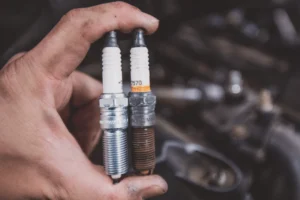
Spark plugs being serviced at Legacy Small Engines

Cause 4: Clogged Air Filter

The air filter prevents dirt and debris from entering the engine. On a trimmer that’s been used through a full season and stored over winter, the filter can be clogged enough to starve the engine of the air it needs to fire.

Locating and checking the air filter is usually straightforward. It sits in a plastic housing, typically near the rear of the engine, secured by one or two screws or clips.
  • A foam filter can be washed in warm soapy water, rinsed, allowed to dry fully, and lightly oiled before reinstalling.
  • A paper filter should be tapped gently to dislodge loose debris and held up to a light source. If you can’t see light through it clearly, replace it. Paper filters cannot be washed.

If the air filter is heavily soiled or has been in service for more than one season, replacement is the better call regardless of how it looks on inspection.

Cause 5: Clogged Carburetor

If fresh fuel, a new spark plug, and a clean air filter haven’t resolved the problem, the carburetor is the next place to look. On a trimmer that ran on old fuel over winter, the tiny jets and passages inside the carburetor are likely coated in varnish deposits that are restricting fuel flow.

A quick diagnostic step before disassembly: remove the air filter and spray a short burst of carburetor cleaner directly into the carburetor intake, then attempt to start the trimmer. If it fires briefly and then dies, the engine itself is fine and the carburetor is the problem.

A thorough carburetor cleaning involves disassembling the unit, soaking the components, and clearing every passage. This is a job that’s manageable for someone experienced with small engine work, but the carburetor on a 2-stroke trimmer is more delicate than on a lawn mower, with smaller jets and more intricate gaskets. Reassembling it incorrectly causes further problems. For most homeowners, professional service is the more reliable path at this point.

Carburetor being repaired at Legacy Small Engines

Cause 6: Clogged Spark Arrestor Screen

This one is specific to 2-stroke engines and is often overlooked. Most gas trimmers have a small mesh screen inside the muffler called a spark arrestor. Its job is to prevent sparks from exiting the exhaust, which is particularly important when using the trimmer near dry grass or brush.

Over time, carbon deposits from 2-stroke combustion build up on this screen and restrict exhaust flow. When exhaust can’t escape properly, the engine loses power, runs erratically, or refuses to start altogether.

To check the spark arrestor:

  1. Locate the muffler on the side of the engine.
  2. Remove the cover and find the small mesh screen inside.
  3. Inspect the screen for heavy carbon buildup. If it’s partially or fully blocked, it needs to be cleaned or replaced.
  4. The screen can often be cleaned with a wire brush and a spray solvent. If it’s damaged or heavily corroded, replace it. Replacement screens are inexpensive and available at most small engine shops.

Cause 7: Primer Bulb Cracked or Not Priming

The primer bulb is the small rubber or clear plastic button on the side of the carburetor that draws fuel into the system before starting. If the bulb is cracked, hardened, or not drawing fuel, the engine won’t get the initial fuel it needs to fire.

Check the bulb visually. It should be soft and flexible, with no visible cracks. When you press it, you should see fuel moving through it if the bulb is clear, or feel resistance if it’s opaque.

A primer bulb that is cracked, hardened from age, or not responding is an inexpensive part to replace and a straightforward fix.

When to Stop DIY and Call a Shop

The steps above cover the most common causes and are all reasonable starting points for a homeowner with basic tools. There are a few situations where professional service is the better call:
  • The carburetor has already been disassembled or adjusted and the trimmer still won’t run correctly
  • The engine pulls easily but never fires at all after addressing the fuel, plug, and air filter
  • The trimmer runs but won’t hold a consistent idle or surges repeatedly
  • There is visible damage to the recoil starter, throttle cable, or engine housing

In these cases, the problem is likely something beyond basic tune-up territory, and attempting further DIY diagnosis without the right tools can sometimes make a straightforward repair more expensive.

How Legacy Small Engines Handles Trimmer Repairs

At Legacy Small Engines in Stittsville, weed trimmer repairs are a regular part of what we do, particularly in spring when machines come out of winter storage and refuse to start. We work on all major brands including Stihl, Husqvarna, Echo, Craftsman, Troy-Bilt, Ryobi, and more.

Whether it’s a carburetor clean, a spark plug and air filter service, a primer bulb swap, or a spark arrestor cleaning, the diagnosis is done properly before any work begins and you get a clear upfront estimate before anything is touched. No surprises.

Pick-up and delivery is available across Stittsville, Kanata, Nepean, Richmond, and the surrounding area, so you don’t need to find a way to transport the trimmer yourself. Check the pricing page for pick-up rates. (Pricing may vary. Contact us for a free upfront estimate.)

Frequently Asked Questions

Why won’t my weed trimmer start after sitting all winter?
The most likely cause is degraded fuel. Ethanol-blended gasoline breaks down within 30 days, and after a full Ottawa winter in storage, old fuel leaves varnish deposits in the carburetor that restrict fuel flow. Drain the old fuel, mix a fresh batch at the correct 50:1 ratio, and work through the spark plug and air filter checks before concluding the carburetor needs professional service.

What fuel does a gas weed trimmer use?
Most gas weed trimmers run on a 2-stroke engine that requires a mixture of fresh gasoline and 2-stroke engine oil. The correct ratio is typically 50:1, but varies by manufacturer. Running a 2-stroke trimmer on straight gasoline causes immediate and often irreversible engine damage. Always confirm the correct mix ratio in your operator’s manual.

How do I know if my weed trimmer engine is flooded?
Signs of a flooded engine include the trimmer cranking but not firing, a strong smell of fuel from the exhaust, or a wet spark plug tip. To clear it, set the choke to the open (run) position, hold the throttle open, and pull the cord 15 to 20 times to burn off the excess fuel.

How often should I replace the spark plug on my weed trimmer?
Once per season is a reasonable standard, or whenever the plug shows signs of fouling, carbon buildup, or a worn electrode. On a 2-stroke trimmer, carbon buildup happens faster than on a 4-stroke engine, so annual replacement is worth doing regardless of how the plug looks.

Can I use the same 2-stroke oil for my trimmer, chainsaw, and leaf blower?
Generally yes, provided the oil is rated for air-cooled 2-stroke engines and you use the correct mix ratio for each machine. Always check the operator’s manual for each piece of equipment, as ratios can vary between models and manufacturers.

My trimmer starts but dies after a few seconds. What’s wrong?

This usually points to a partially clogged carburetor or a clogged spark arrestor screen. The engine fires on the initial fuel drawn in by the primer but can’t sustain a run because fuel flow is restricted or exhaust is blocked. A carburetor cleaning or spark arrestor service typically resolves this.

Get It Running Before the Edges Get Out of Hand

If the trimmer still isn’t cooperating after working through the steps above, the most efficient next move is to have a professional look at it. In most cases, the fix is straightforward once the right diagnosis is made, and the cost is well below what a replacement trimmer would run you.

Here’s how to get it sorted quickly:

  1. Book a pick-up. Flat-rate pick-up and delivery covers Stittsville, Kanata, Nepean, Richmond, and the surrounding area. No vehicle large enough to haul it? Not a problem. Pick-up rates are listed on the pricing page.
  2. Get a clear diagnosis first. We assess the trimmer and give you an honest picture of what’s needed along with an upfront estimate before any work begins. If the repair doesn’t make sense relative to the machine’s age and value, we’ll say so.
  3. Book in minutes. Call 613-899-4809 or fill out the form on the Legacy Small Engines contact page. Let us know the trimmer’s make and model, what it’s doing, and a convenient pick-up time.

Most trimmer repairs are turned around within 24 to 48 hours. During the April and May peak, allow a few extra days. We’ll give you a realistic timeline upfront so you’re not left waiting when there’s work to do.


Table of Contents