
The first warm weekend of spring in Ottawa tends to arrive fast, and the grass doesn’t wait. By the time most homeowners think about pulling the mower out, the lawn already needs a cut.
A walk-behind mower that has spent five or six months sitting in an unheated garage needs more than a prayer and a pull of the cord before it’s ready to work. A proper spring tune-up takes less than an hour, costs a fraction of a repair bill, and is the single best thing you can do to make sure the mower starts reliably and runs well all season. This guide walks through every step, in order, so nothing gets missed.
Before You Start: A Word on Safety
Before touching anything on the mower, disconnect the spark plug wire from the spark plug and tuck it away from the plug. This prevents the engine from accidentally firing while your hands are near the blade or underside of the deck. It takes five seconds and it’s non-negotiable. Do this before every step that involves turning the mower on its side or touching the blade.
Step 1: Do a Visual Inspection First
Before changing anything, take two minutes to look the mower over. An Ottawa winter inside a cold garage can introduce problems you won’t find until you start taking things apart.
Look for:
- Visible cracks or damage to the housing, deck, or handles
- Loose or missing bolts anywhere on the frame or deck
- Frayed or cracked primer bulb on the carburetor
- Condition of the recoil starter rope — if it’s frayed or stiff, note it
- Any signs of rodent activity (nesting material near the engine, chewed wires or hoses)
Rodent damage is more common than most people expect in Ottawa garages. Mice are drawn to the warmth of an engine bay and the smell of fuel residue, and chewed wires or fuel lines can cause problems that aren’t immediately obvious.
Step 2: Change the Oil
This is the first mechanical step and one of the most important. Oil degrades over a season of use and continues to break down chemically during winter storage. Running last year’s oil through a fresh season increases engine wear significantly.
Walk-behind gas mowers should have their oil changed every 25 to 50 hours of use, or at minimum once per season. For most Ottawa homeowners, that means every spring before the first cut.
To change the oil:
- Run the engine for two to three minutes if possible to warm the oil slightly. Warm oil drains more completely than cold oil.
- Disconnect the spark plug wire.
- Drain the old oil by removing the drain plug (if your mower has one), using a siphon pump through the dipstick tube, or by carefully tilting the mower. If tilting, always tilt so the air filter faces up and the carburetor is on the high side. Tilting the wrong way draws oil into the air filter, which causes a whole separate problem.
- Refill with fresh oil to the correct level on the dipstick. Most residential walk-behind mowers take SAE 30 or 10W-30. Check your operator’s manual for the correct spec and quantity.
Don’t skip this step. Oil that’s been sitting through a Canadian winter has lost a meaningful portion of its protective properties, and the first hard pull of the season pushes a cold engine harder than almost anything else.
Step 3: Replace the Spark Plug
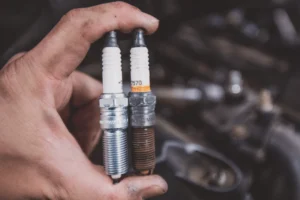
Spark plugs should be inspected every 100 hours of operation and replaced annually as a matter of routine. After a full mowing season and a long winter, a fresh plug is cheap insurance.
A worn or fouled spark plug is one of the leading causes of spring no-starts, rough running, and hard starting throughout the season. The part typically costs less than $10 and the swap takes minutes.
To replace the spark plug:
- Confirm the spark plug wire is disconnected.
- Use a spark plug socket to remove the old plug by turning it counterclockwise.
- If the plug is rusted in place, apply penetrating lubricant to the base and let it soak for 10 minutes before trying again.
- Note the part number on the old plug and match it exactly, or check your operator’s manual for the correct replacement spec. Using a plug with the wrong heat range can damage the engine over time.
- Install the new plug by hand first to avoid cross-threading, then snug it with the socket. Do not overtighten.
- Reconnect the spark plug wire when all other maintenance is complete.
Step 4: Service the Air Filter
The air filter’s job is to keep dirt, dust, and debris out of the engine. After a season of mowing and months of storage, it has almost certainly accumulated enough buildup to affect performance. A clogged air filter starves the engine of oxygen, causes rich-running conditions, and can lead to smoking, sputtering, or starting problems.
Air filters should be serviced every 100 hours of use, or annually. There are two common types:
Paper filter: Cannot be washed. If it’s visibly dirty, grey, or you can’t see light through it when held up to a light source, replace it. Paper filters are inexpensive and available at most hardware stores or through a local small engine shop.
Foam filter: Can be washed in warm soapy water, rinsed, allowed to dry completely, and lightly oiled before reinstalling. If the foam is brittle, torn, or deteriorated, replace it rather than reinstalling it.
Some mowers have both a foam pre-cleaner and a paper filter beneath it. Service both if that’s the case.
Step 5: Address the Fuel System
This step gets the most attention for good reason. Fuel left in the tank over winter is the leading cause of spring small engine problems in Ottawa, and the Ottawa mowing season creates a particularly long storage window: most mowers get put away in October or November and don’t come back out until April or May.
Ethanol-blended fuel (the standard at Ontario pumps) begins to degrade within 30 days. After five to seven months, old fuel leaves varnish deposits in the carburetor and can cause phase separation, where the ethanol and gasoline components separate and the resulting water-ethanol mixture at the bottom of the tank causes rough running or no-start conditions.
If you didn’t run the tank dry or add fuel stabilizer before storage, here is how to approach it:
- Inspect the old fuel in the tank. If it looks dark, has a sour smell, or has visible sediment, drain it completely before adding fresh fuel.
- Add fresh gasoline. Ethanol-free fuel is the better choice for small engines if you can source it locally, as it has a longer shelf life and doesn’t cause phase separation.
- If the mower still won’t start cleanly after fresh fuel and a new spark plug, the carburetor may already be gummed. See our post on what to do when your lawn mower sat all winter with gas in it for the full diagnosis and fix process.
Step 6: Sharpen or Replace the Blade
A sharp blade cuts grass cleanly. A dull blade tears it, leaving ragged tips that turn brown within a day or two and make the lawn look stressed even after a fresh cut. Dull blades also make the engine work harder, increasing fuel consumption and engine wear over the course of a season.
Blades should be sharpened at least once a year. If you mow frequently or have a large property, twice a season is better.
Before inspecting the blade:
- Make sure the spark plug wire is disconnected.
- Tip the mower on its side with the air filter facing up.
- Wear heavy gloves. Even a dull blade can cut.
Inspect the blade for:
- Dullness: Run a gloved finger carefully along the edge. A sharp blade has a noticeable edge. A dull one feels flat or rounded.
- Nicks and gouges: Minor nicks can be sharpened out. Deep gouges or cracks mean the blade needs to be replaced rather than sharpened.
- Balance: An unbalanced blade causes vibration that wears out the mower’s crankshaft and bearings over time. After sharpening, check the balance using a blade balancer or a nail in the wall before reinstalling.
Blade sharpening is a job most homeowners can do with a file or bench grinder if they’re comfortable with it. If you’re not, it’s a straightforward and inexpensive service at a small engine shop.
Step 7: Clean the Deck
Grass clippings, soil, and moisture accumulate on the underside of the mower deck over a full season. Left in place over winter, this buildup can cause rust and corrosion, restrict airflow during cutting, and unbalance the discharge pattern.
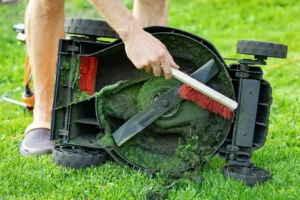
With the spark plug wire disconnected and the mower tipped on its side (air filter facing up), scrape the underside of the deck with a stiff brush or plastic scraper to remove dried clippings and debris. A garden hose can help loosen stubborn buildup. Let the deck dry before storing or using the mower.
While you’re at it, check the discharge chute for blockages and inspect the deck itself for rust spots or cracks that may have developed over winter.
Step 8: Check the Drive System (Self-Propelled Mowers)
If your walk-behind is self-propelled, the drive system deserves a quick check before the season begins. After a winter in an unheated garage, drive cables can stiffen, belts can crack or lose tension, and wheels can seize up from dried grease.
Check the following:
- Drive cable: Squeeze the drive bail and watch the cable move. It should move smoothly and spring back when released. If it’s stiff, sticky, or doesn’t return fully, the cable needs adjustment or replacement.
- Drive belt: With the spark plug wire disconnected, check the belt for cracks, fraying, or glazing on the friction surface. A belt that’s more than a few years old and showing any of these signs should be replaced before it fails mid-season.
- Wheels: Spin each wheel by hand and check that the self-propel mechanism engages cleanly. If a wheel is grinding or hard to turn, it may need lubrication or the axle assembly may need attention.
Step 9: Test Start Before the First Mow
With all eight steps complete, reconnect the spark plug wire and do a test start before you take the mower to the lawn.
Set the throttle to the recommended starting position per your manual (usually full choke for a cold engine). Prime the carburetor with the primer bulb if your mower has one, typically three to five pushes. Pull the cord firmly.
A well-tuned mower should start within two to three pulls on a cold engine. If it takes significantly more than that, or if it starts and then dies, there’s still something to address, most likely a fuel system issue that warrants a closer look.
How Legacy Small Engines Handles Spring Tune-Ups
If the checklist above looks like more than you want to tackle on a Saturday morning, that’s what we’re here for. At Legacy Small Engines in Stittsville, spring tune-ups are one of the most common jobs we do every April, and we service all major brands including Honda, Husqvarna, Toro, Craftsman, Briggs & Stratton, Kohler, and more.
Every tune-up includes a full inspection alongside the core service items: fresh oil, new spark plug, air filter service, blade sharpening, deck cleaning, and a fuel system check. You get a clear picture of the mower’s condition and anything that needs attention is flagged with an honest assessment before any additional work is done.
We also offer an annual lawn mower service subscription starting at $175/year, which covers the full spring tune-up with pick-up and delivery included. The mower gets serviced before the season starts, and you don’t have to think about it. (Pricing may vary. Contact us for a free upfront estimate.)
Frequently Asked Questions
When should I get my walk-behind mower serviced in Ottawa?
Ideally, before the first cut of the season, which in Ottawa typically falls in late April or early May. Getting the mower serviced in March or early April puts you ahead of the spring rush and ensures it’s ready the moment the grass starts growing. If you’re booking with a shop, earlier is better since April and May are the busiest months of the year for small engine repair.
How long does a walk-behind lawn mower tune-up take?
If you’re doing it yourself with the right parts on hand, most of the steps outlined above can be completed in 45 minutes to an hour. At a professional shop, turnaround is typically one to two business days during slower periods and may be a few days longer during the spring peak season.
Can I use last year’s gas if there’s some left in the can?
If the gas is more than 30 days old, it has started to degrade. If it’s from last fall, it should not be used in a small engine without a fuel treatment, and even then, fresh fuel is the better choice. Old fuel from a gas can causes the same carburetor problems as fuel left in the mower’s tank over winter.
What kind of oil should I use in my walk-behind lawn mower?
Most residential walk-behind mowers use SAE 30 or 10W-30 oil. The correct spec for your engine is in the operator’s manual. Using the wrong viscosity can affect how the engine performs and how well it’s protected, especially in cold spring temperatures.
My mower starts but smokes. Is that a tune-up issue?
It can be. Blue or grey smoke usually indicates oil is burning, which can mean too much oil in the crankcase, oil in the air filter from improper tilting, or a worn engine. White or light smoke is often condensation burning off and is usually normal for a few minutes on a cold start. Black smoke typically points to a rich fuel mixture, which can be caused by a clogged air filter or a carburetor that needs cleaning.
Is it worth tuning up an older mower, or should I just replace it?
In most cases, a tune-up is worth it even on an older machine, provided the engine isn’t damaged and the overall condition is reasonable. A tune-up addresses the most common causes of poor performance, and the cost is a small fraction of what a new mower costs. For a more complete look at the repair-versus-replace decision, see our post on whether it’s worth repairing your lawn mower.
Don’t Let the Spring Rush Catch You Off Guard
Walk-in and pick-up slots in April and May fill up quickly. Every year, a significant portion of the tune-up work we handle in spring could have been done in March with a faster turnaround and less stress for the homeowner.
Here is how to get it sorted before the season starts:
- Book a pick-up. We offer flat-rate pick-up and delivery across Stittsville, Kanata, Nepean, Richmond, and the surrounding area. No truck required. Pick-up rates are on the pricing page.
- Choose the right service. A one-off spring tune-up for a single season, or an annual subscription plan starting at $175/year if you want it handled every season without thinking about it. Subscription customers also receive 10% off parts and accessories throughout the year.
- Book in minutes. Call 613-899-4809 or use the form on the Legacy Small Engines contact page. Let us know the mower’s make and model and a convenient pick-up time.
Most spring tune-ups are turned around within 24 to 48 hours. During the May and June peak, allow a few extra days. We’ll give you an honest timeline when you book so you can plan your first mow accordingly.