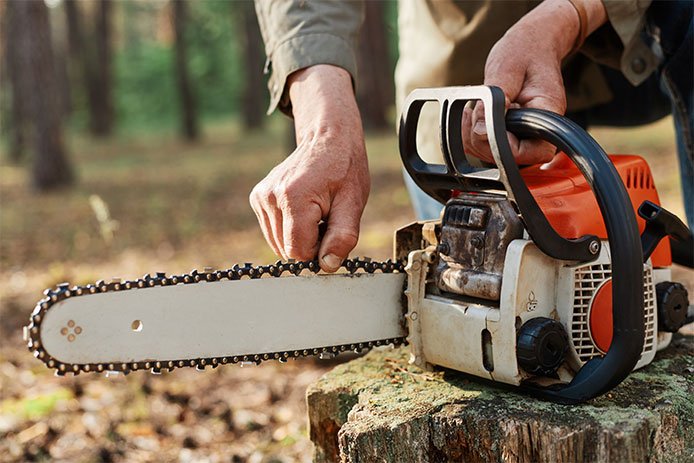
A chainsaw that will not start is a common problem for Ottawa Valley homeowners, and it is usually not a serious mechanical failure. Most no-start issues come down to a few common causes, particularly fuel problems related to storage during Ottawa’s long off-season.
Not all no-start conditions are the same. A dry spark plug points to a different issue than a wet one, while a hard-to-pull starter cord can indicate a mechanical problem. Starting with the simplest and most likely causes helps avoid wasted time and unnecessary parts.
This guide covers the complete diagnostic process, from quick checks to shop-level repairs.
Before You Diagnose Anything: Four Quick Checks
Before removing the spark plug or inspecting the carburettor, check these four basics:
- On/off switch: Make sure it is set to the run position.
- Chain brake: Disengage the chain brake by pulling the front hand guard back toward the front handle.
- Fresh fuel: If the saw has been sitting since last fall, replace the old fuel with a fresh 50:1 mixture.
- Starting procedure: Use the choke for a cold start, but not for a warm restart. Using the choke on a warm engine can flood it.
If these checks are correct and the saw still will not start, move on to the spark plug.
The Fastest Diagnostic: Read the Spark Plug
The spark plug can quickly indicate where the problem is. Remove it after attempting to start the saw and inspect its condition.
- Wet with fuel: The engine is flooded. See the flooding section below.
- Dry: Fuel is not reaching the engine. Check the fuel filter, carburettor, and fuel lines.
- Black and sooty: The engine is running rich, often due to a restricted air filter or choke that is not fully opening.
- White or light grey: The engine may be running lean due to a fuel delivery problem, air leak, or incorrect fuel mixture.
- Heavily fouled, cracked, or worn: Replace the spark plug.
If the Plug Is Wet: Clearing a Flooded Engine
A wet spark plug usually indicates that too much fuel has entered the engine, preventing proper combustion.
To clear a flooded engine:
- Set the choke to fully open, with no choke applied.
- Hold the throttle fully open if your saw allows it.
- Pull the starter cord firmly 15 to 20 times.
- Try starting the saw again using the normal procedure.
If this does not work, remove and dry the spark plug. With the plug removed and the saw positioned safely away from ignition sources, pull the starter several times to help clear excess fuel. Reinstall the plug and try again.
The most common cause of flooding is continuing to use full choke after the engine has briefly fired. Once the engine gives its initial pop, reduce or remove the choke according to the manufacturer’s starting procedure.
If the Plug Is Dry: Fuel Delivery Problems
A dry spark plug usually means fuel is not reaching the engine. Work through these potential causes from most common to least common.
Stale or Degraded Fuel
Stale fuel is one of the most common causes of a dry plug after Ottawa’s winter storage. Gasoline can begin degrading within 30 days, making fuel stored from October to April unreliable. AMSOIL’s chainsaw starting guide
Drain the tank completely and refill it with fresh 50:1 fuel. If the saw starts normally afterward, degraded fuel was likely the problem.
Clogged Fuel Filter
The fuel filter inside the tank prevents debris from reaching the carburettor. Old fuel and accumulated debris can restrict fuel flow and cause the carburettor to run dry.
A common symptom is a saw that starts briefly, then dies and will not restart. If this happens repeatedly, inspect or replace the fuel filter before moving on to the carburettor.
Clogged Carburettor
If fresh fuel and a new filter do not solve the problem, the carburettor may be restricted by varnish from old fuel. A dirty carburettor is a common cause of chainsaw starting problems. AMSOIL’s chainsaw starting guide
Cleaning involves disassembling the carburettor and clearing its fuel passages. If the diaphragm has hardened or cleaning does not restore proper fuel flow, rebuilding or replacing the carburettor may be necessary.
Cracked or Deteriorated Fuel Lines
Old fuel lines can become hard, brittle, or cracked, allowing air into the fuel system and preventing the carburettor from drawing fuel properly.
Inspect the lines for cracks, kinks, or deterioration. If the saw is several seasons old, replacing the fuel lines can be a simple and worthwhile maintenance step.
If the Plug Is Fouled: Ignition and Air System
Replace the Spark Plug
This should happen annually regardless of what else you find. A chainsaw spark plug that has seen one or more Ottawa seasons without replacement is a source of intermittent starting problems, misfiring, and rough running that can easily be mistaken for a more serious problem. A new plug costs a few dollars and takes five minutes to install. It is the first thing to replace before spending time or money on anything else.
When replacing the plug, match the specification in the owner’s manual exactly. Using a plug with the wrong heat range causes exactly the fouling and starting problems you are trying to solve.
Check the Air Filter
A clogged air filter restricts airflow into the carburettor, creating a rich running condition that fouls plugs and causes hard starting. Remove the air filter and inspect it. A paper filter that is dark grey or black with sawdust should be replaced. A foam filter can be washed with warm soapy water, rinsed, dried completely, and reused.
Inspect the Spark Arrestor Screen
The spark arrestor is a small mesh screen in the muffler that prevents hot exhaust particles from escaping. Over time it can become clogged with carbon deposits from oil-rich exhaust, particularly on saws running a richer-than-specified fuel mixture or a lower-quality 2-cycle oil. A clogged spark arrestor restricts exhaust flow enough to prevent the engine from running properly or starting at all.
Remove the muffler cover and inspect the screen. A wire brush cleans a lightly clogged screen. A heavily clogged one should be replaced.
If the Pull Cord Is Unusually Hard: Compression and Mechanical Issues
If the engine is cranking but with noticeably more resistance than usual, or if you feel a hard stop partway through the pull, the problem is mechanical rather than fuel or ignition.
Seized engine. An engine that has been run without adequate lubrication, either from a lean fuel mix, insufficient bar oil, or overheating. A seized engine will not crank at all or will pull through only part of the stroke. This is a shop-level diagnosis.
Hydrolocked cylinder. If bar oil or fuel has pooled in the cylinder, the liquid prevents the piston from completing its stroke. Removing the spark plug and pulling the starter several times with the plug out usually resolves this.
Flooded to the point of hydraulic lock. An extremely flooded engine can behave similarly to a hydro locked one. The same fix applies: remove the plug and dry-pull.
If the pull is hard but not completely locked, and the above steps do not help, the saw needs a compression test and inspection. Low compression from worn or damaged piston rings or a scored cylinder is a less common but real cause of a chainsaw that will not start despite good fuel and spark.
When to Bring It to a Shop
Most Ottawa homeowners can resolve their chainsaw starting problems by working through the sequence above. The point at which a shop visit makes sense is when:
- Fresh fuel, a new spark plug, and a cleared air filter have not resolved the problem.
- The carburettor has been cleaned or replaced and the saw still will not start on fresh fuel with confirmed spark.
- The pull cord is abnormally hard, suggesting internal mechanical resistance.
- There is low or no compression, pointing to piston or cylinder damage.
- The ignition coil needs testing — this requires a spark tester and is not practical without one.
At that point, the remaining causes are genuinely technical and benefit from proper diagnostic tools rather than continued trial and error at home.
Chainsaw No-Start Diagnostic Summary
| Symptom |
Most Likely Cause |
First Action |
| Plug is wet |
Flooded engine |
Choke off, full throttle, pull 15 to 20 times |
| Plug is dry |
No fuel delivery |
Fresh fuel, then fuel filter, then carburettor |
| Plug is black/sooty |
Running rich |
Check air filter; check choke is fully opening |
| Plug is white |
Running lean |
Check fuel mix ratio; inspect fuel lines for cracks |
| Plug is fouled or worn |
Maintenance overdue |
Replace plug; then retest |
| Pull cord unusually hard |
Mechanical issue |
Remove plug, dry-pull; if still hard, bring to shop |
| Starts and dies in 30 seconds |
Fuel starvation |
Fuel filter first, then carburettor |
| Starts briefly on fresh fuel, then dies |
Varnished carburettor |
Carburettor clean or rebuild |
How Legacy Small Engines Diagnoses Chainsaw No-Starts
When a chainsaw comes into Legacy Small Engines in Stittsville, we run through this diagnostic sequence before recommending any repair. The most common result for Ottawa chainsaws that have been through winter storage is a combination of stale fuel, a varnished carburettor, and an overdue spark plug.
We work on all brands of gas chainsaws including Stihl, Echo, Husqvarna, and others, and carry common parts for carburettor service, fuel lines, spark plugs, and air filters. All work comes with a clear upfront estimate before anything is started.
Pick-up and delivery is available across Stittsville, Kanata, Nepean, Richmond, Kinburn, and surrounding areas. *(Pricing may vary. Contact us for a free upfront estimate.)*
Frequently Asked Questions
My chainsaw sat all winter. What should I check first?
Start with the fuel, drain whatever is in the tank and refill with a fresh mixture. Then install a new spark plug. Attempt a proper cold-start sequence. If the saw fires briefly and dies, the carburettor has varnished and needs cleaning. If it will not fire at all despite confirmed spark and fresh fuel, check the fuel filter and fuel lines before moving to the carburettor. In the majority of Ottawa winter-storage cases, fresh fuel plus a new spark plug resolves the problem or clearly points to the next step.
How do I know if my chainsaw is flooded?
A flooded chainsaw has a strong smell of raw fuel, the spark plug tip is wet when removed, and the engine will not fire despite repeated pulling. The fix is to move the choke to the off position, engage the full throttle if possible, and pull firmly 15 to 20 times to clear the cylinder. If that does not work, remove the plug, dry it, dry-pull the starter several times with the plug out, reinstall, and attempt a normal cold start.
My chainsaw starts and runs for 30 seconds, then dies. What is wrong?
This specific pattern almost always indicates fuel starvation. The engine fires on whatever fuel was already in the carburettor, runs until that fuel is exhausted, then dies because the fuel supply from the tank is restricted. Check the fuel filter first; it is inside the tank and can be replaced inexpensively. If the filter is clear, the carburettor inlet passage or fuel line is the next place to look.
Do I need to clean or replace the carburettor?
If the saw has been stored with old fuel, the carburettor almost certainly needs attention. Whether cleaning or replacement is the right call depends on the extent of the varnish buildup and the age of the saw. On most Ottawa homeowner chainsaws, a thorough cleaning resolves the problem. If the internal rubber diaphragm has hardened, a rebuild kit or full carburettor replacement is needed. Replacement carburettors for common models are inexpensive enough that replacement is often more practical than a rebuild on older saws.
How often should I replace the spark plug in my chainsaw?
Every season, at minimum. Most manufacturers recommend replacing the spark plug after every 100 hours of operation, but for Ottawa homeowners who use their chainsaw seasonally, an annual replacement at the start of each cutting season is the simplest and most reliable approach. A new plug costs a few dollars and eliminates one of the most common starting problems before it occurs.
The pull cord is very hard to pull. Is the engine seized?
Not necessarily. Hard pull resistance has several causes, most of which are not a seized engine. First, check that the chain brake is fully disengaged. Second, remove the spark plug and try pulling. If bar oil or fuel has pooled in the cylinder, removing the plug allows it to drain and the resistance disappears. If the pull is still abnormally hard with the plug removed and the brake disengaged, an internal mechanical issue needs professional diagnosis.
Book Your Chainsaw Service
If you have worked through the sequence above and the saw still will not start, or if you would rather have a technician handle the diagnosis from the start, here is how to book:
- Schedule a pick-up. We offer flat-rate pick-up and delivery across Stittsville, Kanata, Nepean, Richmond, Kinburn, and surrounding areas. Pick-up rates are on the pricing page.
- Tell us what the saw is doing. The more specific you can be, the faster the diagnosis when the saw arrives.
- Call or use the contact form. Reach us at 613-899-4809 or through the Legacy Small Engines contact page.
Most chainsaw carburettor and fuel system repairs turn around within 24 to 48 hours. We will give you an honest timeline and estimate before any work begins.
