
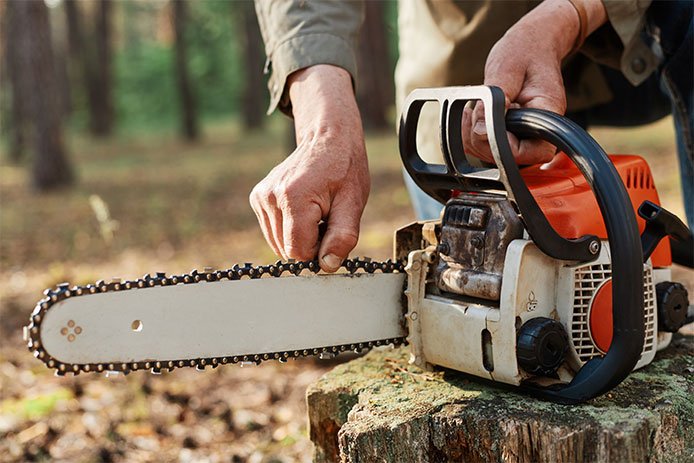
Echo is one of the most widely owned outdoor power equipment brands in Ottawa. Their chainsaws and trimmers deliver reliable performance at a price point that makes quality equipment accessible to homeowners who don’t need commercial-grade gear. The CS-400 and CS-590 Timber Wolf chainsaws are common in Ottawa Valley firewood operations and property maintenance use, and the SRM-225 trimmer is one of the most frequently serviced string trimmers that we see at Legacy Small Engines.
Because home owners frequently run both, this post covers both equipment types. Whether you have a CS-590 that won’t start after winter storage or an SRM-225 that bogs out under throttle, the answers are here.
Already know your Echo needs service? Call 613-899-4809 or book a pick-up. Most repairs turn around within 24 to 48 hours.
Echo Chainsaws: CS-400 and CS-590 Timber Wolf
The Models
CS-400: A mid-range homeowner saw suited for smaller property work, firewood cutting on lots with modest timber, and general cleanup. It is lighter and easier to start than the CS-590, making it a common first chainsaw for Ottawa homeowners.
CS-590 Timber Wolf: Echo’s flagship homeowner chainsaw and the most capable gas-powered saw in their residential lineup. The CS-590 is well-regarded for its power output relative to its size and price, with a reputation that holds up to comparative testing against mid-range Stihl models on firewood cutting tasks. It is the preferred choice for Ottawa homeowners who cut meaningful quantities of firewood each fall.
Both models use a 50:1 gasoline-to-2-cycle-oil ratio and share many of the same maintenance requirements and failure modes.
Common CS-400 and CS-590 Problems
Stale fuel and carburettor varnish after Ottawa storage. The same fuel degradation problem that affects every gas-powered 2-stroke affects Echo chainsaws stored through Ottawa winters. Ethanol-blended fuel sitting in a saw from October through April will leave varnish residue in the carburettor passages that prevents clean fuel delivery on startup. The symptom is a saw that fires briefly and dies, or cranks without catching at all, even with confirmed spark. Drain the old fuel, refill with a fresh 50:1 mix, install a new spark plug, and attempt a cold start. If the saw still won’t run cleanly, the carburettor needs to be cleaned or rebuilt.
A practical approach that many experienced Echo users adopt is using Echo Red Armor 50:1 pre-mixed fuel or a quality synthetic 2-cycle oil with fuel stabiliser added before storage. Pre-mixed fuel in sealed containers does not degrade the way homeowner-mixed fuel does, and it eliminates fuel ratio errors at the same time.
Flooded engine on startup. Like Stihl’s Master Control Lever, the Echo choke system requires a specific starting sequence. A cold start requires the choke on until the engine pops, then choke off to fully start. Using the choke on a warm restart, or continuing to pull with the choke engaged after the initial pop, floods the engine. To clear a flooded Echo chainsaw, move the choke to the off position, set the throttle to full, and pull 15 to 20 times firmly to purge excess fuel from the cylinder. If the engine remains flooded, remove the spark plug, dry it, dry-pull the starter several times with the plug out, reinstall, and attempt a normal cold-start sequence.
Chain oiler problems. A common CS-590 complaint is that the automatic chain oiler becomes inconsistent or stops working entirely after the saw has been in service for several seasons. The oiler delivers bar oil continuously during operation, and running the saw without adequate bar oil rapidly accelerates bar groove and chain wear. If the bar oil reservoir empties faster than expected during cutting, or conversely the saw is running without any visible oil reaching the bar, the oiler requires inspection. Causes range from a clogged oiler port to a worn pump, and both are straightforward repairs.
Spark plug fouling. Both the CS-400 and CS-590 benefit from an annual spark plug replacement regardless of tracked hours. A fouled plug shows up as hard starting, misfiring at idle, or inconsistent power under load. Echo recommends replacing the spark plug each season and matching the plug specification to the model. Using a non-specified plug can cause performance and starting issues.
Echo Trimmers: SRM-225
The Echo SRM-225 is the most widely owned Echo trimmer in Ottawa and one of the most serviced string trimmers in the region. It is a 21.2cc straight-shaft trimmer that strikes a well-regarded balance between weight, power, and reliability. Understanding its specific failure modes saves time and prevents unnecessary parts replacement.
Common SRM-225 Problems
Won’t start after winter storage. The SRM-225 is a 2-stroke engine and shares the same stale fuel vulnerability as every other small gas-powered tool that sits through an Ottawa winter. The carburettor on the SRM-225 uses a diaphragm design that is particularly susceptible to damage from ethanol fuel left to degrade, as the fuel causes the rubber diaphragm to harden and lose its flexibility. A hardened diaphragm cannot pump fuel effectively, resulting in a trimmer that will not start or starts and immediately dies.
The fix depends on the extent of the damage. A recently hardened diaphragm sometimes responds to carburettor cleaning and a fresh fuel flush. A diaphragm that has fully stiffened requires a carburettor rebuild kit or a full carburettor replacement. On the SRM-225, carburettor replacement is a routine and cost-effective repair. Aftermarket carburettors for this model are widely available and inexpensive.
Bogging under throttle: the hidden adjustment screw. The SRM-225 has a specific and well-documented problem where the trimmer starts and idles correctly but bogs down, loses power, or stalls when the throttle is applied. This is one of the most frequently discussed SRM-225 issues in technician forums, and it has a specific cause.
The SRM-225 carburettor has a high-speed fuel mixture adjustment screw that is concealed beneath a limiter cap near the primer bulb. This screw governs how much fuel is delivered at full throttle. When it is set too lean from the factory or after drifting over time — the engine receives insufficient fuel under load and bogs out. Accessing and adjusting this screw requires a small specialized tool to remove the limiter cap, after which the adjustment can be made to richen the high-speed mixture. This repair requires the right tool and some familiarity with carburettor.
Fuel line deterioration. Fuel lines in Echo trimmers, particularly on machines that are several seasons old, are known to harden and crack with age. The plastic used in the fuel lines becomes brittle over time, particularly when the trimmer has been stored with old fuel in the tank repeatedly. Cracked fuel lines allow air to enter the fuel system, disrupting the vacuum needed for the primer bulb to pull fuel and causing hard starting or a no-start condition.
Trimmer head and line issues. The SRM-225 uses a bump-feed trimmer head that requires periodic reloading with trimmer line and occasional replacement of the head itself when the bump mechanism wears. Common issues include:
- Line that won’t feed when the head is bumped, caused by line that has fused together inside the spool from heat during use. Removing and reloading the spool with fresh line resolves this.
- Excessive line breakage, which is usually caused by line that is too light for the work being done or running the head at a height that causes the line to contact hard surfaces repeatedly.
- A stuck or broken bump knob, which prevents the feed mechanism from working and requires replacing the head or the knob depending on the design.
Echo Equipment Maintenance Schedule for Ottawa Conditions
| Task | Echo Recommendation | Ottawa Recommendation |
|---|---|---|
| Fuel mix ratio (both chainsaws and trimmers) | 50:1 gasoline to 2-cycle oil | Always 50:1; use Echo Red Armor or quality synthetic 2-cycle oil |
| Spark plug replacement | Annually | Every spring regardless of hours |
| Air filter cleaning | Every 10 operating hours | Inspect every use; clean or replace each spring |
| Fuel lines (trimmers) | Replace when cracked or stiff | Inspect every spring; replace proactively on machines 3+ years old |
| Primer bulb (trimmers) | Replace when cracked or non-responsive | Inspect and replace alongside fuel lines |
| Carburettor inspection | As needed | Inspect if saw or trimmer sat with fuel over winter |
| Bar oil refill (chainsaws) | Check every use | Refill every time you refuel; never run low |
| Chain sharpening (chainsaws) | As needed | Every 1 to 2 tanks during active cutting |
| Trimmer head inspection | As needed | Each spring; reload line and check bump knob |
| Fuel stabiliser treatment | Before storage | Every fall before putting equipment away |
Echo’s 5-Year Consumer Warranty: What Ottawa Owners Should Know
Echo’s residential equipment carries a 5-year consumer warranty — one of the longest offered by any outdoor power equipment manufacturer. For Ottawa homeowners who purchase a CS-400, CS-590, or SRM-225, this means defects in materials and workmanship are covered for five seasons of use.
Two things are worth understanding about this warranty in practice. First, the warranty covers defects but it doesn’t cover damage from improper fuel mixing, stale fuel, or operator error such as flooding. Second, warranty service requires the equipment to be taken to an authorised Echo dealer, which depending on your location could mean having to ship your equipment or wait for scheduled pickups at a registered vendor. If you’re experiencing a problem with relatively new Echo equipment and are unsure whether it qualifies as a warranty issue, bringing it in for a diagnosis is always a good first step.
Is Echo Equipment Worth Repairing?
For most Echo chainsaws and trimmers, yes. A new Echo CS-590 Timber Wolf retails for approximately $550 to $650 CAD, and the SRM-225 trimmer for approximately $250 to $300 CAD. At those prices, common repairs — carburettor service, fuel line replacement, spark plug replacement, chain and bar work — are clearly cost-effective on machines in otherwise sound condition.
The Echo SRM-225 is particularly worth repairing given how inexpensive carburettor and fuel line parts are for this model. A complete fuel system refresh including carburettor, fuel lines, and primer bulb typically costs a fraction of a new trimmer.
The CS-590 is also worth maintaining given its replacement cost and the availability of parts. Unlike some less-supported brands, Echo parts for these common models are readily available, which keeps repair costs predictable.
For the full repair-or-replace framework, see our post on [whether it’s worth repairing your lawn mower].
How Legacy Small Engines Services Echo Equipment
At Legacy Small Engines in Stittsville, we service Echo chainsaws and trimmers regularly. The SRM-225 carburettor bogging problem and fuel line deterioration are among the most common jobs we see on Echo equipment, and both are well within our standard scope. When an Echo chainsaw or trimmer comes in, we run a proper fuel system and compression diagnostic before recommending any repair — because a carburettor replacement on a trimmer that actually needs a fuel line is an unnecessary cost.
We carry common Echo-compatible parts for carburettor service, fuel lines, primer bulbs, spark plugs, and trimmer heads. All work comes with a clear upfront estimate before anything is started.
Pick-up and delivery is available across Stittsville, Kanata, Nepean, Richmond, Kinburn, and surrounding areas. (Pricing may vary. Contact us for a free upfront estimate.)
Frequently Asked Questions
My Echo SRM-225 starts fine but bogs down when I give it throttle. What’s wrong?
This is the most well-known SRM-225 problem, and it almost always comes down to the high-speed fuel mixture adjustment. The SRM-225 carburettor has a concealed high-speed adjustment screw beneath a limiter cap near the primer bulb. When this screw is set too lean, the engine receives insufficient fuel under load and bogs out or stalls. Accessing and adjusting it requires a small specialised tool. If you are not comfortable with carburettor adjustments, this is a straightforward shop repair.
What fuel mix does Echo equipment use?
Both Echo chainsaws and Echo trimmers require a 50:1 gasoline-to-2-cycle-oil mixture — 2.6 oz of 2-cycle oil per gallon of gasoline. Echo recommends their own Red Armor 2-cycle oil or an equivalent quality synthetic. Using a pre-mixed fuel like Echo Red Armor 50:1 eliminates mixing errors and extends storage life compared to homeowner-mixed fuel, which is particularly useful for Ottawa owners who store equipment over the long winter.
How long does an Echo CS-590 last?
With proper annual maintenance — fresh spark plug each spring, clean air filter, correct fuel mix, and fuel drained or stabilised before winter storage — a well-maintained CS-590 Timber Wolf is designed for many seasons of reliable service. Echo’s 5-year consumer warranty reflects the company’s confidence in the machine’s durability under normal residential use conditions.
My Echo chainsaw or trimmer sat all winter with fuel in it. What should I do before starting it?
Drain the old fuel completely from the tank and carburettor. Refill with a fresh 50:1 mix. Replace the spark plug. On a trimmer, also inspect the primer bulb and fuel lines for cracks or stiffness before attempting to start — deteriorated fuel lines are a common cause of starting failure on Echo trimmers that have been stored with old fuel. Attempt a normal cold-start sequence. If the engine fires briefly and dies, the carburettor likely needs cleaning.
Why does my Echo trimmer’s line keep breaking or not feeding?
Frequent line breakage is usually caused by trimmer line that is too light for the conditions, or by running the head at an angle that causes the line to contact hard edges repeatedly. The Echo SRM-225 is designed for .095-inch diameter trimmer line for standard residential use — using lighter line increases breakage frequency. If the line is not feeding when the head is bumped, the most common cause is line that has fused or welded together inside the spool from heat. Remove the spool, separate or cut away the fused section, and reload with fresh line.
Is Echo equipment sold at Canadian Tire or Home Depot in Ottawa?
Yes. Echo chainsaws and trimmers are sold at Canadian Tire and Home Depot locations across Ottawa, which distinguishes Echo from Stihl, which is only available through authorised dealers. This also means Echo parts are more readily available at local retailers for straightforward maintenance items like spark plugs, air filters, and trimmer line.
Yes. Echo chainsaws and trimmers are sold at Canadian Tire and Home Depot locations across Ottawa, which distinguishes Echo from Stihl, which is only available through authorised dealers. This also means Echo parts are more readily available at local retailers for straightforward maintenance items like spark plugs, air filters, and trimmer line.
Book Your Echo Service Before the Season Starts
For chainsaws, the best time to service is late summer before fall firewood cutting. For trimmers, the best time is early spring before the first cut. Getting ahead of the seasonal rush means faster turnaround and equipment that is ready when you need it.
Here is how to book:
- Schedule a pick-up. We offer flat-rate pick-up and delivery across Stittsville, Kanata, Nepean, Richmond, Kinburn, and surrounding areas. Pick-up rates are on the pricing page.
- Tell us the model and what it is doing. Letting us know whether you have a CS-400, CS-590, or SRM-225 and describing the specific symptom.
- Call or use the contact form. Reach us at 613-899-4809 or through the Legacy Small Engines contact page.Most Echo chainsaw and trimmer repairs turn around within 24 to 48 hours. We will give you a realistic timeline when you book.