
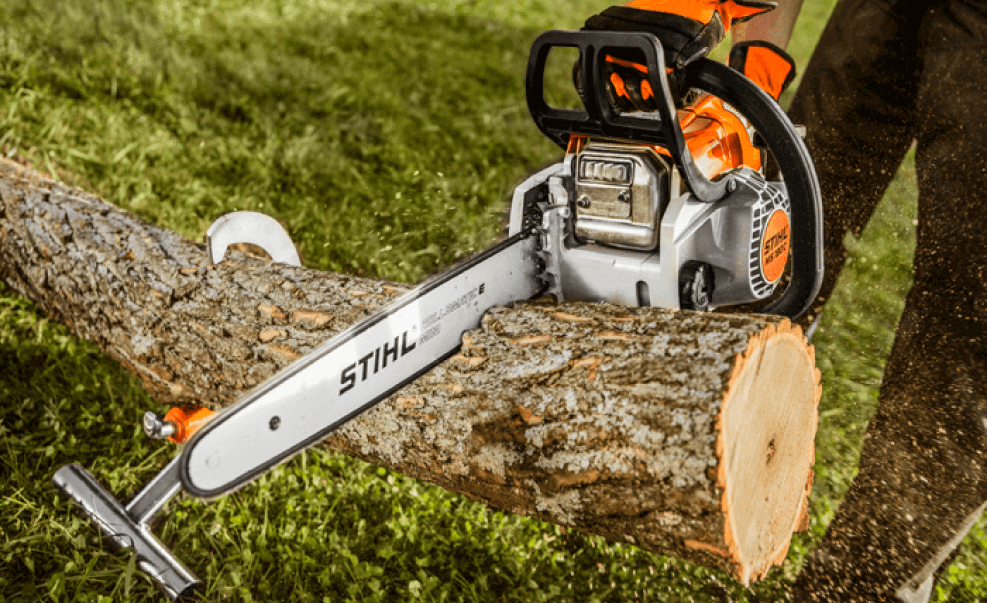
Stihl is the dominant chainsaw brand in the Ottawa Valley by a wide margin. From Stittsville and Kanata to Kinburn, Richmond, and Carleton Place, the orange-and-grey saws are the tool of choice for firewood cutting, land clearing, storm cleanup, and property maintenance. The MS250, MS271, and MS291 are the three models most commonly owned by Ottawa homeowners, covering the range from light property work up to serious firewood production on larger rural lots.
Stihl builds quality equipment, but these saws have specific characteristics that affect how they start, how they fail, and what keeps them running reliably through Ottawa’s demanding seasonal cycle. Understanding those characteristics prevents most of the problems that send chainsaws to the shop.
Already know your Stihl needs service? Call 613-899-4809 or book a pick-up. Most chainsaw repairs turn around within 24 to 48 hours.
The Three Models: MS250, MS271, and MS291
Before getting into common problems, a brief note on what differentiates these three saws — because the differences affect which failure modes are most relevant to you.
MS250: The lightest of the three, designed for occasional homeowner use including limbing, bucking smaller logs, and general property maintenance. It uses a simpler carburettor design and does not have a decompression valve. For Ottawa homeowners who use a chainsaw a handful of times per season, this is the most common entry point into the Stihl lineup.
MS271: A mid-range saw positioned between homeowner and professional use. It is heavier and more powerful than the MS250, suited for regular firewood cutting and more demanding work on larger properties. The MS271 includes a decompression valve, which reduces the pull effort required for starting — a feature many owners forget to use.
MS291: The most powerful of the three, designed for sustained firewood production, larger felling work, and heavier-duty use on acreages and rural properties. Like the MS271, it includes a decompression valve. The MS291 has a reputation for excellent cutting performance but is also the model most commonly damaged by incorrect fuel mixing or lean running conditions.
All three are 2-stroke engines requiring a 50:1 gasoline-to-2-cycle-oil mixture. Getting that ratio right is not optional — it is the single most important maintenance decision for any of these saws.
The Most Common Stihl Chainsaw Problems in Ottawa
Stale Fuel and Carburettor Varnish
Stihl’s own guidance is that fuel should not be left in the saw for more than 60 days. For Ottawa owners who use a chainsaw seasonally — primarily in fall for firewood cutting and occasionally in spring for storm cleanup — this means the saw is routinely stored for far longer than that between uses.
A 2-stroke fuel mix sitting in a chainsaw through an Ottawa winter does not simply go stale — it separates, the oil settles, and the gasoline leaves a varnish residue in the carburettor passages and fuel lines that prevents proper fuel delivery when the saw is next started. The symptoms are predictable:
- The engine fires briefly on the primer bulb fuel and then dies, refusing to sustain running.
- The engine cranks but never catches despite confirmed spark.
- The engine starts and runs at idle but bogs out or dies when throttle is applied, indicating a partially blocked high-speed circuit in the carburettor.
The fix begins with draining all old fuel from the tank and carburettor float bowl, refilling with a fresh 50:1 mix, and attempting to start. If the saw still will not run cleanly, the carburettor needs to be cleaned. On the MS250, the carburettor is a straightforward diaphragm design that cleans well. On the MS271 and MS291, carburettor cleaning is also the standard repair for fuel-related no-starts, though replacement is sometimes more practical on saws with significant varnish buildup after multiple seasons of improper storage.
Running the fuel tank dry before putting the saw away — or treating a fresh mix with a quality fuel stabiliser — prevents this problem entirely.
Flooded Engine: The Most Common Stihl Starting Error
Engine flooding is the single most common reason Ottawa homeowners cannot start their Stihl chainsaw, and it is almost always caused by incorrect use of the Master Control Lever during startup rather than any mechanical failure.
Stihl’s Master Control Lever combines the choke and throttle functions into a single control. For a cold start, the lever is set to the full choke position, the engine is pulled until it fires and dies — the “pop” — and then the lever is moved to the run position for the engine to fully start. The critical mistake happens when owners miss the pop and continue pulling with the choke still engaged. Each additional pull delivers more fuel into the cylinder without the engine firing, flooding the combustion chamber to the point where the spark plug cannot ignite the over-rich mixture.
On a hot restart — such as stopping for a fuel break and restarting — the engine is already warm and does not need any choke at all. Using the choke on a hot restart almost guarantees flooding.
Clearing a flooded Stihl follows a specific procedure:
1. Move the Master Control Lever to the run position (no choke) and engage the throttle lock so the throttle is held open at full.
2. Pull the starter cord firmly 15 to 20 times with the choke off and throttle fully open. This allows air to purge the excess fuel from the cylinder.
3. If the engine still will not fire, remove the spark plug, dry it with a cloth, dry-pull the starter 4 to 5 times with the plug removed to expel fuel from the cylinder, reinstall the plug, and attempt a normal cold-start sequence.
On MS271 and MS291 models, pressing the decompression valve before each pull reduces the effort required significantly and makes clearing a flooded engine much less physically demanding.
Incorrect Fuel Mix and Engine Damage
This is the most serious preventable problem affecting Stihl chainsaws in Ottawa, and it is worth addressing plainly: running a Stihl chainsaw on straight gasoline, or on an incorrectly mixed fuel with too little oil, will score the piston and cylinder walls and can render the saw unserviceable.
The required mix is 50:1 — 2.6 oz of 2-cycle oil per gallon of gasoline. The oil in the mix is the only lubrication the piston and cylinder receive, since 2-stroke engines do not have a separate oil sump. Running a lean mix removes that lubrication and generates heat and friction that scores the cylinder walls within a short operating time.
The MS291 is particularly susceptible to this damage because it runs hotter under load than the MS250 or MS271. A scored piston shows up as a saw that has lost compression — it pulls easily but will not fire, or fires weakly without power. Confirming a scored piston requires removing the muffler and visually inspecting the cylinder wall through the exhaust port while turning the engine over. Visible scoring on the piston face confirms the diagnosis.
A scored piston and cylinder is repairable through a piston and ring replacement with cylinder honing, but it is a more involved repair than carburettor or fuel system work. Stihl recommends using Stihl-branded 2-cycle oil or a quality equivalent, and mixing fresh batches rather than storing pre-mixed fuel for extended periods.
Spark Plug Fouling and Wear
Stihl recommends replacing the spark plug every 100 hours of operation. For Ottawa homeowners who use their saw for firewood cutting over several weekends in fall, 100 hours accumulates more slowly than on a saw used commercially — but a plug that has seen several seasons without replacement is overdue regardless of tracked hours.
A fouled plug shows up as:
- Hard starting that improves dramatically once the plug is replaced.
- Inconsistent spark, causing the engine to misfire or run rough at idle.
- A black, sooty electrode indicating a rich running condition, often combined with carburettor issues.
Replacing the spark plug at the start of each season — regardless of tracked hours — is the single highest-return maintenance habit for any Stihl chainsaw. It costs a few dollars and eliminates the plug as a variable in any starting or running diagnosis.
Chain, Bar, and Sprocket Maintenance
The cutting components of a Stihl chainsaw require their own maintenance attention that is separate from the engine. A dull chain forces the engine to work harder, generates more heat, and dramatically increases cutting time and operator fatigue.
Key maintenance points for Ottawa firewood and property work:
- Chain sharpening should happen regularly — most experienced Ottawa firewood cutters touch up the chain after every tank of fuel or two during a cutting session. A sharp chain cuts with light downward pressure. If you find yourself pushing the bar into the wood to make progress, the chain is dull.
- Bar oil must be kept filled throughout every cutting session. The automatic oiler lubricates the bar groove and drive sprocket continuously during operation, and running low on bar oil causes accelerated bar and chain wear. Check the bar oil reservoir every time you refuel.
- Drive sprocket wear is often overlooked but matters for chain life. A worn sprocket develops a hooked tooth profile that accelerates chain stretch and causes the chain to skip. Replacing the sprocket at the same time as a new chain prevents premature chain wear on a fresh installation.
- Bar rotation — flipping the bar end-for-end at regular intervals — distributes wear evenly across both rails rather than allowing one side to wear faster than the other.
Decompression Valve: The Feature MS271 and MS291 Owners Forget
The decompression valve on the MS271 and MS291 is a small button on the engine casing that, when pressed before each starting pull, releases a small amount of cylinder pressure and makes the recoil starter much easier to pull. Stihl’s official starting procedure lists pressing the decompression valve as an early step in the sequence.
Owners who are unfamiliar with the feature, or who have forgotten it exists, often report that their MS271 or MS291 is unusually hard to start or requires excessive pulling effort. In many cases, consistently using the decompression valve is the only change needed. The valve resets automatically once the engine fires, so it needs to be pressed again for each subsequent cold start.
Stihl Chainsaw Maintenance Schedule for Ottawa Conditions
| Task | Stihl Recommendation | Ottawa Recommendation |
|---|---|---|
| Fuel mix ratio | 50:1 gasoline to 2-cycle oil | Always 50:1; never use straight gas or old mix |
| Maximum fuel age in saw | 60 days | Run tank dry before storage; treat fresh mix with stabiliser for off-season |
| Spark plug replacement | Every 100 hours | Every spring before first use regardless of hours |
| Air filter cleaning | Every 10 operating hours | Inspect every use; clean or replace each spring |
| Bar oil refill | Check every use | Refill every time you refuel; never run low |
| Chain sharpening | As needed | Every 1 to 2 tanks during active cutting |
| Drive sprocket inspection | Every chain replacement | Inspect every chain replacement; replace if hooked |
| Carburettor inspection | As needed | Inspect if saw sat over winter with fuel in tank |
| Decompression valve use (MS271/MS291) | Before each cold start pull | Before every cold start pull; press again if required |
Is a Stihl Chainsaw Worth Repairing?
In most cases, yes — and often clearly. A new Stihl MS250 retails for approximately $450 to $500 CAD, the MS271 for approximately $600 to $650 CAD, and the MS291 for approximately $700 to $800 CAD. At those prices, carburettor service, fuel line replacement, spark plug replacement, and bar or chain work are all well within a reasonable repair threshold.
The only repair that warrants a more careful evaluation is a scored piston and cylinder on an older saw. Piston and cylinder replacement is possible and does restore the engine to serviceable condition, but the cost relative to the saw’s age and remaining service life needs to be assessed honestly. A scored MS291 that is five or six years old with moderate hours is generally still worth repairing. An older MS250 with multiple seasons of heavy use requires a judgment call on remaining value.
For the broader repair-or-replace framework, see our post on [whether it’s worth repairing your lawn mower](https://legacysmallengines.com/blog/is-it-worth-repairing-your-lawn-mower/) — the same principles apply to chainsaws.
How Legacy Small Engines Services Stihl Chainsaws
At Legacy Small Engines in Stittsville, we service Stihl chainsaws across the MS-series range. When a Stihl comes in, we run through a systematic diagnosis that covers the fuel system, spark plug, compression, and carburettor before recommending any repair — because misdiagnosis on a chainsaw is common, and carburettor work on a saw that actually has a scoring problem is a waste of money.
We carry common Stihl-compatible parts for carburettor service, fuel lines, spark plugs, air filters, and bar and chain components. All work comes with a clear upfront estimate before anything is started.
Pick-up and delivery is available across Stittsville, Kanata, Nepean, Richmond, Kinburn, and surrounding areas. *(Pricing may vary. Contact us for a free upfront estimate.)*
Frequently Asked Questions
My Stihl MS250 won’t start after sitting all winter. Where do I start?
Begin with the fuel. Drain whatever is in the tank — it has been sitting long enough to degrade and varnish the carburettor passages. Refill with a fresh 50:1 mix, install a new spark plug, and attempt a proper cold-start sequence using the Master Control Lever. If the engine fires briefly and then dies, the carburettor needs to be cleaned. If the engine will not fire at all despite confirmed spark and fresh fuel, compression and ignition are the next things to check.
How do I know if my Stihl is flooded?
A flooded Stihl has a strong fuel smell, the spark plug tip is wet with fuel when removed, and the engine will not fire despite repeated pulling. The fix is to move the Master Control Lever to the run position with full throttle engaged and pull 15 to 20 times without any choke. If that does not clear it, remove the spark plug, dry it off, dry-pull the starter several times with the plug out to expel fuel from the cylinder, then reinstall and attempt a normal start.
What happens if I use the wrong fuel mix in my Stihl?
Running a Stihl chainsaw on straight gasoline or an under-oiled mix — anything leaner than the required 50:1 ratio — removes lubrication from the piston and cylinder. The result is scoring on the cylinder wall, loss of compression, and a saw that will not run with any power. This damage is visible through the exhaust port with the muffler removed. It is repairable through piston and cylinder replacement, but it is an avoidable and expensive repair.
My MS271 or MS291 is very hard to pull to start. What should I check?
The first thing to check is whether you are pressing the decompression valve before each pull. It is a small button on the engine casing that releases cylinder compression and makes the recoil starter significantly easier to operate. Many owners are unaware of it or forget it is part of the starting procedure. If you are using the decompression valve and the pull is still abnormally hard, the engine may have developed a compression issue that warrants a shop inspection.
How often should I sharpen the chain on my Stihl?
During active firewood cutting, most experienced Ottawa users sharpen or touch up the chain every one to two tanks of fuel. A sharp chain cuts with minimal downward pressure and produces curled wood chips rather than fine dust. When you notice you are pushing the bar into the wood to make progress, or the saw is producing fine sawdust instead of chips, the chain is due for sharpening.
Can I use any 2-cycle oil in my Stihl chainsaw?
Stihl recommends their own branded 2-cycle oil or a quality full-synthetic equivalent rated for air-cooled 2-stroke engines. Avoid automotive 2-stroke oils, which are formulated for water-cooled engines and can leave more combustion deposits in an air-cooled saw. The oil type matters less than the ratio — always 50:1 — but using a quality oil designed for air-cooled equipment gives the engine the best protection under load.
Get Your Stihl Serviced Before Firewood Season
Fall firewood cutting in the Ottawa Valley starts in September and October for most homeowners. Getting the chainsaw serviced in late summer — a fresh plug, clean carburettor, new air filter, and a compression check if the saw is several seasons old — means it is ready when the wood needs to come in, not sitting in a queue at a shop in October when everyone else has the same idea.
Here is how to book:
1. Schedule a pick-up. We offer flat-rate pick-up and delivery across Stittsville, Kanata, Nepean, Richmond, Kinburn, and surrounding areas. No truck required. Pick-up rates are on the pricing page.
2. Tell us the model and what it is doing. Letting us know it is an MS250, MS271, or MS291 and whether the issue is a no-start, a running problem, or just a spring service allows us to prepare the right parts and diagnostic approach before the saw arrives.
3. Call or use the contact form. Reach us at 613-899-4809 or through the Legacy Small Engines contact page.
Most chainsaw tune-ups and carburettor services turn around within 24 to 48 hours. We will give you a realistic timeline when you book.