
Husqvarna has been making outdoor power equipment since 1919, and their walk-behind lawn mowers are among the most commonly owned gas mowers in the Ottawa market. The HU series in particular, which covers their residential self-propelled and push models, is a familiar sight in Ottawa garages alongside equipment from Honda, Toro, and Craftsman.
Husqvarna walk-behind mowers have a few specific characteristics that affect how they’re serviced and what problems typically surface after a long Ottawa storage season. Knowing what to expect makes spring startup less frustrating and helps owners make better decisions about when to repair, when to service, and when something needs professional attention.
What Makes Husqvarna Walk-Behind Mowers Different
A few things set Husqvarna’s walk-behind lineup apart from other brands, and they matter for maintenance and repair purposes.
Multiple engine options across the range. Unlike Honda, which powers its own residential mowers exclusively with GCV-series engines, Husqvarna’s walk-behind lineup uses different engines depending on the model tier. Entry and mid-range models use Honda GC-series or Briggs & Stratton engines. Higher-spec models in the HU series use Husqvarna’s own engine designs. This means that before diagnosing an issue on a Husqvarna mower, it’s worth knowing which engine is actually in it, because the service approach can differ meaningfully between a Briggs-powered model and a Honda-powered one.
ReadyStart chokeless starting system. Most Husqvarna gas mowers use a ReadyStart system rather than a conventional manual choke or autochoke mechanism. ReadyStart is designed to let the mower fire on a cold engine without the operator having to set a choke position, simplifying the starting process. It works through a priming and fuel delivery system tuned to the engine’s specifications. When it works properly, it’s genuinely convenient. When it starts to fail, it produces specific symptoms that are worth recognizing.
Steel cutting decks with powder coating. Husqvarna’s walk-behind gas mowers use powder-coated steel decks rather than composite materials. Steel decks are durable and handle impacts well, but they require more attention to prevent rust and grass buildup, particularly after Ottawa’s wet springs and in the humid cutting conditions of summer.
All-wheel drive models. The AWD variants in the Husqvarna HU range use a more complex drive system that provides independent traction at all four wheels. This works well on uneven Ottawa terrain, but adds drive components that need periodic attention and are worth inspecting during annual service.
The Most Common Husqvarna Walk-Behind Problems in Ottawa
Starting Failure After Winter Storage
The most frequent reason any gas walk-behind mower, Husqvarna included, comes into a shop in spring is a fuel system problem from winter storage. Ottawa’s mowing season ends in October or November, and most machines sit on old, degraded E10 fuel for five to seven months before anyone tries to start them. The result is varnish buildup in the carburetor that restricts fuel delivery and prevents reliable starting.
On Husqvarna mowers, this shows up as hard starting, an engine that fires briefly then dies, or a machine that won’t fire at all despite a functioning spark plug. Draining the old fuel and refilling with fresh gasoline is always the first step. If the problem persists, a carburetor service is the reliable fix.
ReadyStart System Failure
Husqvarna’s ReadyStart system makes starting straightforward when it’s working correctly. When it begins to fail, the typical symptoms are harder cold starts than the mower previously required, a need to prime repeatedly before the engine catches, or an engine that starts and then runs erratically for the first few minutes before settling.
The ReadyStart system depends on a correctly functioning primer bulb, clean fuel delivery passages, and the right fuel-to-air ratio being maintained during the cold start phase. After several seasons of use, the primer bulb can harden and crack, the internal check valves can gum up from old fuel residue, and fuel line connections can develop small leaks that affect starting performance.
ReadyStart issues are often misread as general starting problems or attributed immediately to the carburetor. A technician familiar with Husqvarna mowers will check the ReadyStart components specifically before pulling the carburetor.
Drive Belt Wear and Self-Propel Failure
On self-propelled Husqvarna walk-behind models, drive belt problems are one of the more common repair jobs. The drive belt transfers engine power to the rear wheels, and it experiences significant wear over the course of a mowing season.
Signs of a worn or failing drive belt include the self-propel engagement feeling sluggish or unresponsive, the mower losing drive power on slopes where it previously had no trouble, a squealing or slipping sensation when the drive is engaged, or the self-propel stopping working entirely. On AWD models, if drive power is uneven between the front and rear wheels, worn or misaligned belts are usually the cause.
Drive belts are straightforward to replace and the job is significantly less expensive than allowing a worn belt to break mid-season. A spring service is the logical time to inspect belt condition, particularly on a mower that has covered three or more seasons.
Steel Deck Rust and Buildup
The powder-coated steel decks on Husqvarna walk-behind mowers hold up well, but they’re not immune to rust, particularly if grass clippings and moisture are left on the underside of the deck for extended periods. Ottawa’s combination of wet spring conditions and long winter storage creates a prime environment for deck corrosion to develop.
Surface rust on the deck underside is mostly cosmetic and slows development with regular cleaning. More significant rust that penetrates the powder coating and begins eating through the deck wall is worth monitoring, because once it progresses to holes or structural thinning around the blade mounting, the deck becomes a safety concern.
Cleaning the deck underside after every few mows and rinsing it down before winter storage prevents most deck corrosion problems. At spring startup, tip the mower to inspect the underside and catch any rust development before it advances.
Safety Switch Faults
Husqvarna walk-behind mowers use an operator presence bail on the handle that shuts the blade and sometimes the engine when released. The blade stop and engine kill functions are controlled by safety switches that, over time, can stick, corrode, or fail in a way that prevents the mower from starting at all despite everything else being in working order.
If the mower seems otherwise fine but simply won’t start, and fresh fuel, a new spark plug, and a clean air filter haven’t resolved it, a faulty safety switch is worth checking. This is particularly common on older machines where the switch contacts have been through multiple seasons of weather exposure.
Husqvarna Mower Lifespan and Whether Repairs Are Worth It
Husqvarna rates parts availability for their mowers at over ten years, which reflects how the brand approaches product longevity. In practice, a well-maintained Husqvarna walk-behind is realistically capable of lasting ten to fifteen seasons, with proper parts available to keep it running for that full period.
The repair value equation for Husqvarna walk-behind mowers is similar to the general framework: if the repair costs less than roughly half the replacement value, and the machine is otherwise in reasonable condition, repair is the better financial decision. Given that new Husqvarna HU-series self-propelled mowers typically retail from $600 to $850 CAD, most common repairs fall well inside that threshold.
The exception is significant engine damage, either from an extended oil starvation event or a major impact, on an older entry-level model. In that specific case, the cost of engine reconditioning or replacement on a lower-tier machine may approach or exceed replacement cost, and a professional assessment is the right starting point. For a full walkthrough of the repair-or-replace decision framework, see our post on whether it’s worth repairing your lawn mower.
Husqvarna Walk-Behind Maintenance Schedule for Ottawa Conditions
Husqvarna provides recommended service intervals in every operator’s manual, but Ottawa’s long storage season pushes some of those intervals toward the conservative end.
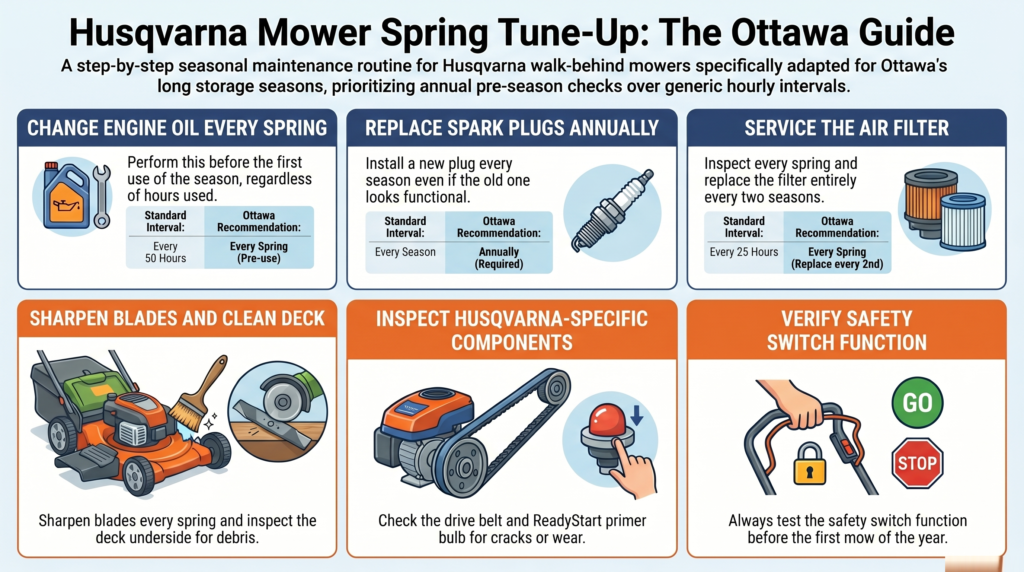
| Task | Standard interval | Ottawa Local recommendation |
|---|---|---|
| Engine oil change | Every 50 hours or annually | Every spring before first use |
| Spark plug replacement | Every season | Annually, regardless of appearance |
| Air filter service | Every 25 hours or as needed | Every spring; replace if two seasons old |
| Drive belt inspection | As needed | Inspect every spring; replace if worn |
| Blade sharpening | As needed | Minimum every spring |
| Deck cleaning | After each use | Rinse before storage; inspect underside each spring |
| ReadyStart primer bulb | Replace if cracked | Inspect every spring; replace proactively on older machines |
| Safety switch test | As needed | Test function before each season |
The drive belt and ReadyStart primer bulb inspections are the two Husqvarna-specific additions that don’t appear on a generic mower maintenance list. On a machine with three or more seasons of use, both are worth checking at the same time as the standard spring service.
How Legacy Small Engines Services Husqvarna Mowers
At Legacy Small Engines in Stittsville, we service Husqvarna walk-behind mowers regularly and carry parts for the most common HU-series models. When a Husqvarna comes in, we identify which engine it’s running first, then work through the diagnostics in a sequence appropriate for that specific machine, including the ReadyStart system and drive components that a generic tune-up checklist might not address.
All work comes with a clear upfront estimate before anything is started, and no repairs proceed without your go-ahead. If a machine has multiple issues, we’ll give you an honest picture of what it would cost to address all of them versus the value of the mower, so you can make a fully informed call.
Pick-up and delivery is available across Stittsville, Kanata, Nepean, Richmond, and surrounding areas. *(Pricing may vary. Contact us for a free upfront estimate.)*
Frequently Asked Questions
How long should a Husqvarna walk-behind lawn mower last?
With proper annual servicing and reasonable care, a Husqvarna HU-series walk-behind mower is built for ten to fifteen seasons of residential use. Husqvarna guarantees parts availability for over ten years on their mowers, which gives owners the practical ability to maintain the machine for that full lifespan.
My Husqvarna mower starts fine when warm but is hard to start cold. What’s the issue?
This is typically a ReadyStart system problem. The primer bulb, check valves, or fuel delivery passages may have degraded or accumulated residue from old fuel, causing the system to under-deliver fuel during the cold start phase. It can also be a spark plug issue. Start with a new spark plug; if the problem continues, the ReadyStart components need inspection.
The self-propel on my Husqvarna isn’t working. Is that expensive to fix?
Drive belt replacement is one of the more common and affordable repairs on self-propelled Husqvarna mowers. If the belt is worn or has broken, the repair is straightforward. On AWD models, the diagnosis is slightly more involved since there are multiple drive points to check, but it’s still typically a belt or cable issue rather than a major mechanical failure.
My Husqvarna mower shuts off when I release the handle. Is that a fault?
That’s the operator presence bail functioning as designed. The bail on the handle cuts the blade or engine when released as a safety feature. If the mower is shutting off when you’re still holding the handle, that points to a faulty safety switch, a loose connection at the bail mechanism, or a wiring issue. This is worth having looked at, as a safety switch fault can also prevent the mower from starting at all.
Which engine is in my Husqvarna walk-behind mower?
It depends on the model and the year it was made. Many HU-series residential models use Honda GC or GCV engines, while others use Briggs & Stratton or Husqvarna’s own power units. Check the engine casing directly for a brand name and model number, or look up your mower’s model number on Husqvarna’s website. Knowing the engine brand matters when sourcing parts and when servicing the carburetor.
Should I use ethanol-free fuel in my Husqvarna mower?
Yes, particularly in Ottawa where storage runs five to seven months. Husqvarna recommends a maximum of E10 fuel, but ethanol-free gasoline stores significantly better over long off-season periods and causes far less carburetor varnish buildup. If you’re storing the mower with fuel in the tank, either run it dry before storage or treat a full tank of fresh ethanol-free fuel with a stabilizer.
Book Your Husqvarna Service Before the Season Starts
Spring service slots fill up quickly once the grass starts growing. Getting in ahead of the May rush means a faster turnaround and the mower is ready when you need it, not after it. Here’s how to book:
1. Schedule a pick-up. Flat-rate pick-up and delivery covers Stittsville, Kanata, Nepean, Richmond, and surrounding areas. Pick-up rates are on the pricing page
2. Tell us what you have. Let us know it’s a Husqvarna and the model number if you have it. That allows us to confirm parts on hand and prepare for the specific engine and drive system in your machine.
3. Call or use the contact form. Reach us at 613-899-4809 or through the Legacy Small Engines contact page Standard tune-ups and common repairs typically turn around within 24 to 48 hours. During the May and June peak, allow a few extra days. We’ll give you a realistic timeline when you book so you can plan accordingly.