

Honda lawn mowers have a reputation for lasting a long time, and Ottawa homeowners who own one usually know it. The GCV-series engines powering the HRR and HRX lineups are widely regarded as among the most reliable residential mower engines built, and it’s common to encounter Honda mowers that are ten, twelve, even fifteen years old and still cutting well.
That longevity doesn’t come without maintenance, though, and Honda mowers do have a set of specific characteristics that affect how they need to be serviced and what problems are most likely to surface when they’ve been through an Ottawa winter. This post covers what Honda owners in the Ottawa area need to know: the common issues, what’s worth repairing, and how to keep a Honda running the way it was designed to.
What Makes Honda Mower Engines Different
The GCV160 and GCV200 engines found in Honda’s residential HRR and HRX mowers use an overhead cam (OHC) design rather than the side-valve configuration used in many competing engines. In practical terms, this means the engine runs at cooler temperatures, produces less vibration, and tolerates extended operation better than older-style small engine designs.
The overhead cam design also means that valve clearances are more critical than on a simpler side-valve engine. Over time, the intake and exhaust valves can accumulate carbon deposits or lose proper clearance, which causes a gradual loss of compression and the hard-starting or surging behaviour that Honda owners sometimes experience on older machines.
Honda residential mowers also feature an autochoke system rather than the manual choke lever found on most competitor mowers. The autochoke opens and closes automatically based on engine temperature, which makes starting simpler for the user but adds one more component that can wear out or fail, particularly after years of service.
Both of these characteristics, valve wear and autochoke function, are worth knowing about because they affect how a Honda should be diagnosed when it starts behaving unexpectedly.
The Most Common Honda Lawn Mower Problems in Ottawa
Carburettor Issues from Stale Fuel
The single most frequent reason a Honda mower comes into a shop in spring is a carburettor affected by degraded fuel. This is true of all small engine equipment, but it’s worth noting that the GCV-series carburettors are precision components with small jets and passages that are particularly sensitive to the varnish deposits that ethanol fuel leaves behind after a long storage period.
Ottawa’s mowing season ends in October or November, and the mower typically doesn’t come back out until April or May. That’s a five to seven month window for E10 fuel to break down and leave residue behind. A Honda that ran perfectly at the end of last season and now won’t start, surges at idle, or dies after a few minutes is almost always dealing with a fuel system issue from storage.
Fresh fuel is always the first step. If the problem persists after a fuel change and a new spark plug, a professional carburettor service is the reliable next move.
Autochoke Failure
Honda’s autochoke mechanism relies on a thermal spring that responds to engine temperature. When the engine is cold, the spring holds the choke closed to enrich the fuel mixture for starting. As the engine warms, the spring opens the choke to a normal running position.
Over time, particularly on machines that have accumulated several seasons of use, the spring can weaken or the choke mechanism can stick. When this happens, the engine may flood on cold starts, run rich and produce black smoke, or refuse to transition properly from choke to normal running position.
This is a Honda-specific issue that doesn’t affect mowers with manual chokes, and it’s one that not every shop will think to check first. A technician familiar with Honda mowers will test the autochoke early in the diagnostic process.
Valve Carbon Buildup and Sticky Valves
On a Honda GCV engine that has covered several seasons, carbon buildup on the valves or a slight loss of valve clearance can cause the engine to feel sluggish, lose power under load, or become difficult to start despite a clean fuel system.
A simple diagnostic for this: with the spark plug removed, pull the starter cord slowly through its stroke and pay attention to how much resistance you feel as the engine passes through the compression stroke. A healthy engine has a firm, definite resistance at that point. If the cord pulls through with noticeably less resistance than expected, compression may be down and the valves are worth inspecting.
Valve adjustments and decarbonising are routine servicing tasks for a technician experienced with Honda engines.
Spark Plug Issues Unique to the GCV Series
Honda recommends a specific spark plug type for the GCV series, and using the wrong replacement can cause intermittent misfires, hard starting, or even cracking of the plug’s ceramic insulator. The engine produces enough heat under certain conditions that a plug with the wrong heat range fails faster and less predictably than it would in a lower-output engine.
When replacing the spark plug on a Honda GCV mower, matching the part number exactly, or confirming the correct replacement spec in the operator’s manual, is more important than it is on some other small engines.
Is a Honda Mower Worth Repairing?
In most cases, yes, and often more clearly so than with budget mowers. Here’s the reasoning.
Honda mowers sit at the upper end of the residential walk-behind market. The HRR series retails from approximately $700 to $900 CAD, and the HRX series climbs higher from there. That purchase price means the repair threshold under the 50% rule is meaningfully higher than it would be for a $350 entry-level mower. Most repairs, including carburettor work, autochoke replacement, valve adjustment, and even some engine reconditioning, come in well under that threshold on a Honda.
Beyond the numbers, Honda mowers are designed to last. Many owners in Ottawa report their Honda mowers running reliably well past the ten-year mark with regular servicing. A machine built to that standard is worth maintaining, and a one-off repair on a well-kept Honda is almost always a better financial decision than replacing it with something of similar quality.
The main exception is when major engine damage has occurred, typically from running low on oil for an extended period or from a crankshaft impact. In those cases, the repair cost can approach or exceed replacement value, and a professional assessment is the right first step.
For a broader framework on the repair-or-replace decision, see our post on whether it’s worth repairing your lawn mower.
Honda Mower Maintenance Schedule for Ottawa Conditions
Honda’s standard maintenance intervals are a good baseline, but Ottawa’s long storage season warrants treating some of them as minimum standards rather than aspirational targets.
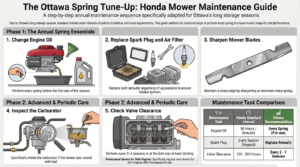
| Task | Honda’s recommended interval | Ottawa Local recommendation |
|---|---|---|
| Engine oil change | Every 50 hours or annually | Every spring before first use |
| Spark plug inspection | Every season | Replace annually regardless |
| Air filter service | Every season or 25 hours | Every spring — replace if aged |
| Blade sharpening | As needed | At minimum every spring |
| Carburettor inspection | As needed | Inspect if stored with fuel |
| Valve clearance check | Every 100–300 hours | Every 2–3 seasons, or at first sign of hard starting |
The valve clearance check in particular is one that many homeowners skip because it’s not part of a standard tune-up at most general shops. On a Honda GCV engine approaching five or more seasons of use, it’s worth asking specifically about when booking a service.
How Legacy Small Engines Services Honda Mowers
At Legacy Small Engines in Stittsville, we work on Honda mowers regularly and are familiar with the GCV160 and GCV200 engines that power the HRR and HRX lineups. When a Honda comes in, we don’t just run a standard tune-up checklist. We’re well trained and able to check the autochoke function, assess compression, and inspect the fuel system with Honda’s specific carburettor design in mind.
All work comes with a clear upfront estimate before anything is started. We stock common Honda parts and can source less common components quickly, which keeps turnaround time short. We also carry genuine replacement parts where they make a difference to performance and longevity, because on a Honda engine, the right part matters.
Pick-up and delivery is available across Stittsville, Kanata, Nepean, Richmond, and the surrounding area. *(Pricing may vary. Contact us for a free upfront estimate.)*
Frequently Asked Questions
How long should a Honda lawn mower last with proper maintenance?
Honda GCV-series engines are among the longest-lasting in the residential market. With consistent annual servicing, oil changes, and proper off-season storage, it’s realistic to expect a Honda HRR or HRX mower to remain in reliable service for fifteen years or more. Many Ottawa homeowners are still mowing with machines purchased in the early 2010s.
My Honda mower starts but surges at idle. What’s causing it?
Surging at idle, where the engine speed rises and falls rhythmically, almost always points to a partially restricted carburettor passage. The main jet or pilot jet is receiving limited fuel flow, causing the engine to hunt for a stable running point. A carburettor cleaning typically resolves this. If the problem persists after a clean, a worn or incorrectly adjusted autochoke mechanism is worth investigating.
Why is my Honda mower hard to start even with a new spark plug?
On a Honda GCV engine, hard starting after a fresh plug and clean fuel system is often a compression issue. The valves may need adjustment, or carbon deposits on the valve seats may be preventing a full seal. This is more common on machines with five or more seasons of use and is a routine fix for a technician familiar with Honda engines.
Can any small engine shop work on a Honda mower, or do I need a Honda dealer?
Most small engine repair shops can service Honda mowers for routine maintenance and common repairs. The key is finding a shop that’s familiar with the GCV engine’s specific characteristics, particularly the autochoke system and valve clearance requirements, rather than applying a generic tune-up approach. Legacy Small Engines services Honda mowers regularly and stocks Honda-compatible parts.
My Honda HRX has a NeXite deck. Does it need any special maintenance?
The NeXite composite deck doesn’t rust or dent the way steel decks do, which reduces one category of maintenance. The underside still accumulates grass and debris over a season and should be cleaned regularly to maintain airflow and cutting efficiency. Honda warrants the NeXite deck against rust and corrosion for the life of the mower, but that warranty doesn’t extend to the engine and drivetrain components, which still need regular servicing.
Should I use ethanol-free fuel in my Honda mower?
Honda’s official guidance for the GCV series permits fuel containing up to 10% ethanol. However, given Ottawa’s long storage season and how aggressively E10 degrades over several months, ethanol-free fuel is a better practical choice for Ottawa homeowners. It remains stable longer, doesn’t cause phase separation in the carburettor, and reduces the risk of the varnish deposits that cause most spring starting problems.
Book Your Honda Mower Service Before the Season Starts
A Honda mower is worth looking after properly, and the spring service window fills up quickly. Every year the demand peaks in May and wait times extend. March and early April are when turnaround is fastest.
Here’s how to get it sorted:
1. Book a pick-up. Flat-rate pick-up and delivery runs across Stittsville, Kanata, Nepean, Richmond, and surrounding areas. No truck needed. Rates are on the pricing page
2. Tell us what you have. When you book, let us know it’s a Honda and the model if you have it. That allows us to have the right parts on hand and means fewer delays if something needs replacing.
3. Call or use the contact form. Reach us at 613-899-4809 or through the Legacy Small Engines contact page
Most Honda tune-ups and standard repairs turn around within 24 to 48 hours. During peak season in May and June, add a few days. We’ll give you a realistic timeline when you book.